A Gentle Breathing Practice for Settling Wind
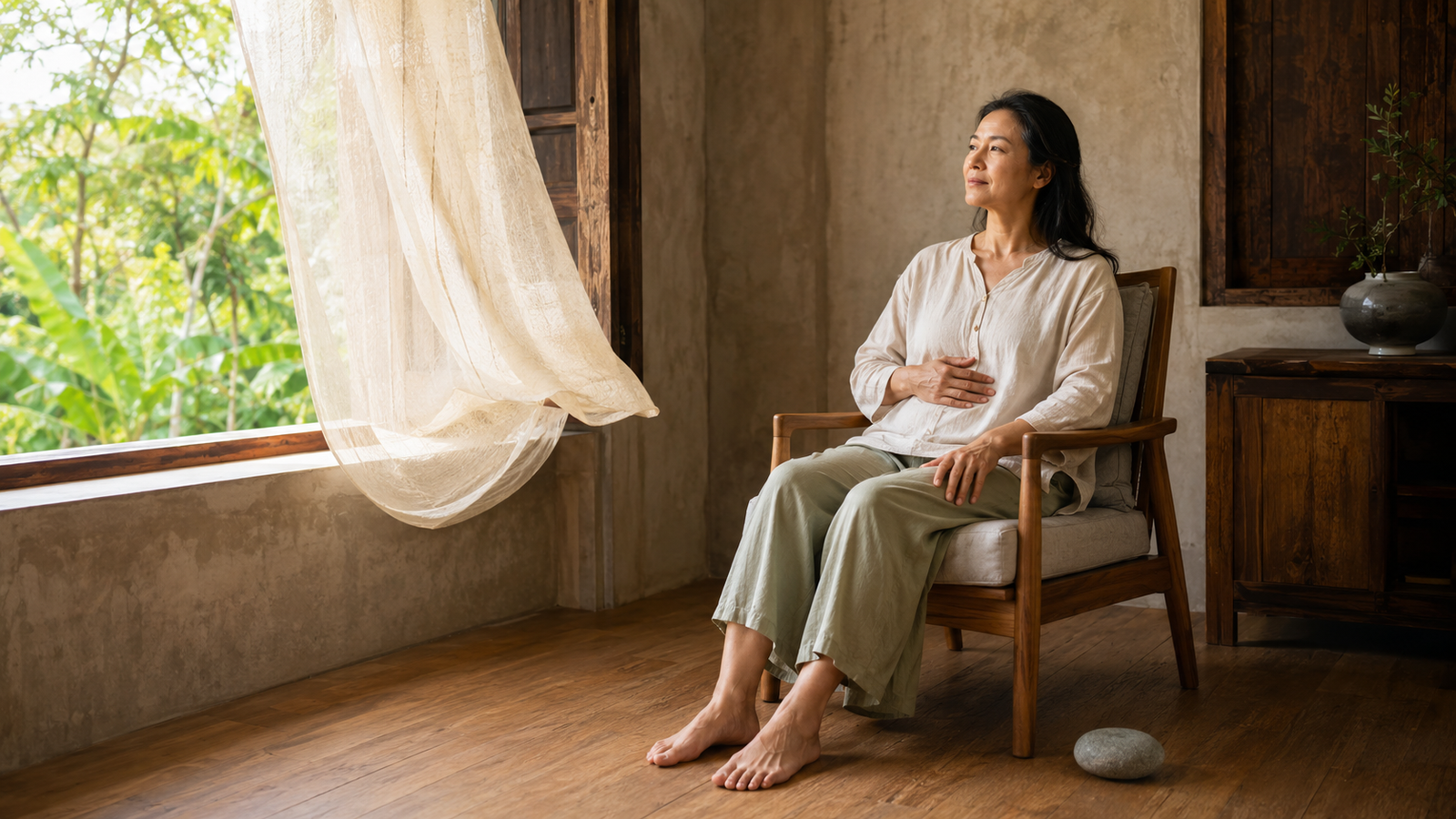
Use a slow, comfortable breath as an anchor when thoughts, stimulation and the pace of life feel difficult to settle.
Breathing is one of the few bodily rhythms that happens automatically and can also be influenced consciously.
We cannot command ourselves to become calm. But we can sometimes create gentler conditions through the way we breathe.
Slow, comfortable breathing has been studied for its effects on heart rate, heart-rate variability and perceived stress. The evidence does not mean that one pattern works for everyone or that breathing can instantly "reset" the nervous system.
It suggests something more modest and useful:
The breath can become a point of contact with the present moment.
## BREATH THROUGH THE ELEMENTAL LENS
Within Thai Longevity Method, Wind—or Lom (ลม)—offers a traditional language for movement and rhythm.
When thoughts are moving quickly, input has become constant or the day has offered no clear ending, the experience may feel recognisably Wind-like.
This is not a diagnosis of excess Wind, and Wind is not another name for the nervous system.
It is a reflective way of asking:
What is still moving—and what might help it find a steadier rhythm?
Breathing gives that movement something simple to follow.
## A NOTE ABOUT THE PRACTICE
The exercise below is a Thai Longevity Method practice. It is not presented as a named classical technique from Thai Traditional Medicine.
It brings together the Method's understanding of Wind and modern evidence suggesting that slow-paced breathing may support relaxation and influence aspects of autonomic activity.
Some research has found that a slightly longer exhalation may increase certain measures associated with cardiac vagal activity. But a strict one-to-two ratio is unnecessary and may feel uncomfortable for some people.
The breath should never become another performance.
## THE PRACTICE
Sit in a position that feels supported.
You may place both feet on the floor, rest your back against a chair or lie down if that is more comfortable.
Allow your hands to rest somewhere they do not need to hold themselves up.
First, notice your natural breathing without changing it.
Then try the following:
1. Breathe in gently through your nose for a comfortable count of three.
2. Breathe out slowly for a count of four or five.
3. Let the next breath arrive naturally without holding or pulling it in.
4. Continue for approximately two or three minutes.
The numbers are not important.
If counting makes you tense, simply allow the exhalation to become a little softer and longer than the inhalation.
The breath should remain quiet and comfortable. Do not take unusually large breaths. Slow breathing is not the same as forcing deep breathing.
## GIVE ATTENTION SOMEWHERE TO LAND
As you breathe, feel one physical point of contact:
Your feet meeting the floor.
Your back against the chair.
Your hands resting in your lap.
The weight of your body being supported.
This is where Earth meets Wind within the Method.
Wind brings movement. Earth provides something stable enough to receive it.
If thoughts continue, you have not failed. The purpose is not to empty the mind. It is to give attention a rhythm and a place to return.
## USE TRANSITIONS, NOT ONLY CRISES
This practice may be especially helpful at transition points:
* After closing the laptop
* Before entering your home after work
* Between two demanding appointments
* Before beginning an evening routine
* When you notice that your body has stopped but your attention is still racing
Practising at transitions can help create a clearer boundary between one part of the day and the next.
It does not "retrain the nervous system's baseline" in three minutes, and it should not be used to promise permanent calm.
Its value is simpler.
It helps you practise arriving.
## WHEN TO STOP
Stop and return to your natural breathing if you feel dizzy, breathless, tingling, panicked or uncomfortable.
Anyone with a respiratory or cardiovascular condition, or who finds breath-focused practices distressing, should seek individual guidance from an appropriately qualified professional.
Breathing practices are supportive tools. They are not substitutes for medical or psychological care, and they should never be used to push through severe or unfamiliar symptoms.
## AN ANCHOR, NOT A COMMAND
The breath does not need to control the mind.
It can simply accompany it.
Over time, returning to one gentle rhythm may become a familiar signal that you no longer need to respond to everything at once.
Not a command to calm down.
An invitation to come back.
When Wind feels scattered, the question is not:
How do I force myself to be still?
It is:
What rhythm would help me feel supported in this moment?
Sometimes the answer begins with one unforced breath.
*This article offers general wellbeing information and is not a substitute for individual medical or psychological care.*
Further reading: [Systematic review of slow-breathing research](https://pubmed.ncbi.nlm.nih.gov/30245619/) · [Research on inhalation and exhalation ratios](https://www.mdpi.com/2071-1050/13/14/7775)
Written by
Jean Lumi
Founder of the Thai Longevity Method, blending traditional Thai elemental medicine with modern nervous system science to help people live with greater calm, resilience and vitality.
About Jean LumiA practical guide to finding calm in a world that will not slow down.
Discover The Patience Reset