Cortisol Is Not the Enemy: A More Useful Way to Think About Stress
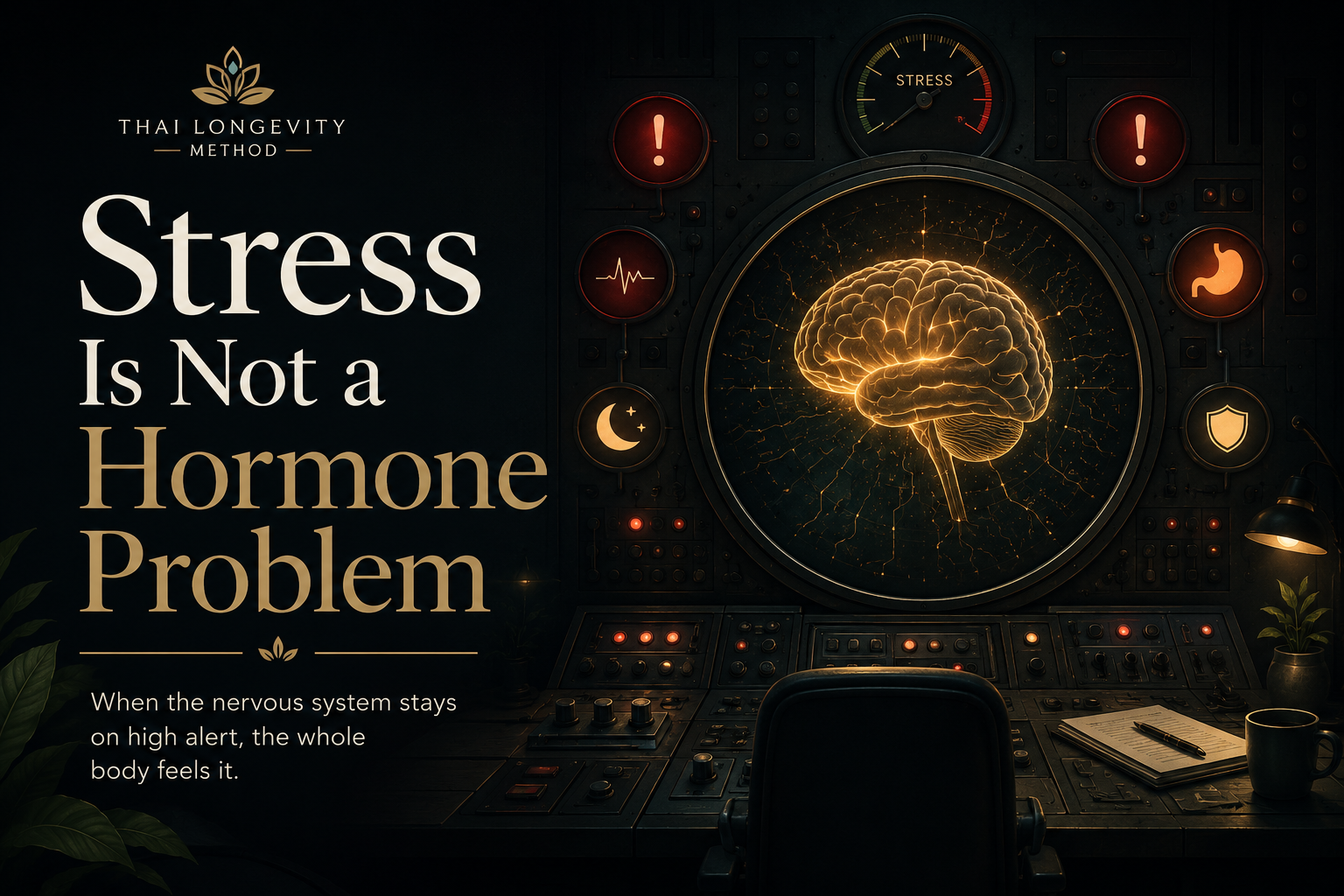
Cortisol is an important part of the stress response, not a wellness villain. A gentler look at stress, recovery and what your daily patterns may be telling you.
Cortisol has become one of wellness culture's favourite villains.
Poor sleep? Cortisol.
Feeling stressed? Cortisol.
A difficult afternoon? Probably cortisol again.
The reality is more interesting.
Cortisol is an essential hormone involved in our natural daily rhythms and the body's response to challenge. We need it. The goal is not to eliminate cortisol—or to interpret every uncomfortable feeling as evidence that something hormonal has gone wrong.
Stress is also bigger than any one hormone.
Sleep, workload, relationships, uncertainty, movement, recovery, health and environment can all shape how we experience demanding periods.
This is where I find the elemental lens useful—not as a replacement for physiology, but as another way of paying attention.
Within Thai Longevity Method, Wind gives us a language for movement and pace.
When life feels permanently in motion—notifications, unfinished tasks, racing thoughts, irregular rhythms—reflecting on Wind can become a way of asking:
*What has become too fast?*
Earth, by contrast, invites us to notice structure and support:
*What helps me feel grounded?*
*Which routines are genuinely supporting me?*
*Where might I need a clearer boundary?*
These questions cannot diagnose a cortisol problem or explain what is happening in a laboratory result.
They do something simpler—and often more immediately useful.
They help us notice the conditions surrounding our stress.
From there, we can consider what kind of support may be possible: a more consistent sleep rhythm, a few minutes without input between tasks, gentle movement, slower breathing, time outdoors or saying no to one demand that never needed to become ours.
None of these practices is a universal solution. Sometimes the right response is professional medical or psychological support—particularly when symptoms are persistent, severe, unfamiliar or interfering with daily life.
The point is not to blame cortisol.
Nor is it to turn every difficult season into an elemental imbalance.
It is to become more curious about the wider context in which stress is occurring.
Sometimes the most useful question is not:
*How do I lower this number?*
It is:
*What is my life asking my body to carry right now?*
JL
Written by Jean Lumi
Written by
Jean Lumi
Founder of the Thai Longevity Method, blending traditional Thai elemental medicine with modern nervous system science to help people live with greater calm, resilience and vitality.
About Jean LumiA short, gentle reflection to notice which element may be asking for attention right now.
Find Your Current Element